Hello all or dobrý den,
In case you forgot (or didn't know) I'm Katharine and I am a Tufts University junior currently studying abroad in Prague. After a week and a half, I've started to settle in so I offer you my reflections on my first 10 days experiencing Prague and the Czech culture. Unfortunately I forgot my camera cord so I don't have any pictures to upload but hopefully I can share some with you soon.
The Language
The official language of the Czech Republic is not surprisingly Czech so all CIEE students are required to learn the language. For the next 2 weeks, we only have intensive Czech class for 5 hours a day and once the regular semester courses begin, we will drop it down to twice a week. The language is quite challenging and unlike anything I've ever studied. While "no" is one of three ways to say "yes", "čau" is pronounced the same as "ciao" and has the same meaning. Consonants are common and words like "zmrzlina" (ice cream) and "čtyři" (four) and quite a mouthful. Our Czech buddies say it will be difficult to learn Czech, but I'm hoping to soon have some knowledge so I don't have to rely on my English.
The Food
The food is awful. Czech cooking relies heavily on meats and bread/potatoes. I do like meat, but most of the kind they serve in the cheaper restaurants is fatty pork or beef. I was excited to try the goulash with dumplings, but was disappointed to be served a plate of beef with slices of white bread. Another thing Czech cuisine lacks is fresh foods. Produce is scarce and when I visited Tesco to purchase groceries I settled for bags of frozen fruits and vegetables. Lean chicken is nearly impossible to find at stores as is skim milk. It will truly be an adjustment to make the most of what is offered at the grocery stores here (though if somebody wants to open a Whole Foods in Praha 2, I would not be opposed!) Another huge part of Czech dining is beer, or pivo. At restaurants beer is cheaper than water. Pubs line the streets and at all hours of the day you can see Czechs enjoying a beer on the sidewalks, at the bar, or along the river. While beer is the common beverage of choice, water is not. Water at restaurants is not free and water fountains are hard to find. Luckily I am the queen of carrying water bottles, though I ditched my favored Nalgene bottle for a Bobble bottle that has a filter in it.
The Buildings
Prague is postcard perfect. The buildings in Europe (though I've only seen Zurich, Prague and Karlovy Vary) put those in America to shame. From the grandeur of Prague Castle to even our simple dorm, the architecture is stunning. I have no clue what style the buildings here but hopefully after my Art & Architecture of Prague class I will know more. I'm in awe every time I travel down the cobblestone streets at how fairytale-like Prague is. Most days I run along the river with a scenic view of the castle that is hard to beat, though the cobblestone is sure hard on my knees. I can't imagine living in a city that is so beautiful. I'm excited to explore the surrounding towns and other European cities to see more buildings.
The People
My friends and family know that I can be quite loud, but here in Prague my voice is probably alarming. Czech people are very reserved. On the trams and metro, most of the conversations I hear are in languages other than Czech. Czech people stereotype Americans as loud and obnoxious and if you ride on a late-night tram with a bunch of rowdy American study abroad students, you would see how they came to this conclusion. Another interesting thing is that our study abroad director told us not to make eye contact with our professors. Making eye contact is uncomfortable for the Czech people. Coming from a town where people say "hi" and smile to people they pass on the street, this will be quite different for me.
Overall Prague has been an incredible experience so far. My favorite moment was when we went to a dance club last Friday for 80s/90s night. The walls had huge tv screens playing American songs from Bon Jovi to Spice Girls. Though many people there did not speak English, most knew the words to every song. I also have heard American music in other establishments--from Justin Bieber in Tesco to Rihanna at a restaurant, I am keeping up with all the current tunes. I look forward exploring the city even more and hopefully traveling to more European destinations. Feel free to comment here or email me at katharine.majewski@tufts.edu and I will get back to you!
Katharine
Wednesday, September 5, 2012

Monday, April 23, 2012
Using Social Media to Make a Difference
Social media continues to grow as millions of users check Facebook, Twitter, Pinterest, and more each day. Though people have brought up many negatives about the growing expanse of social media, one huge positive is that some people are using it for social change. Last week in my class we played The ReDistricting Game (click here to play). Brought to you by the USC Game Innovation Lab, the online game allows users to take a hands-on approach to learning about active citizenship and politics. Many other online games were created to engage and inform people. These mediums are important because so many people are online for many hours of the day, yet they still need to be informed about global and national issues. In addition to games that educate players on current issues, other social media sites can be used as a platform for education.
Social media is not only used in relation to current issues, but people are also using social media to further causes. I recently took part in the Harvard relay team challenge through Swim Across America, a non-profit organization that raises money for cancer research. Most people on my college swim team took part in the event and pledged to raise money. Within days of signing up, posts on both Facebook and Twitter started popping up regarding the swim.


Social media is not only used in relation to current issues, but people are also using social media to further causes. I recently took part in the Harvard relay team challenge through Swim Across America, a non-profit organization that raises money for cancer research. Most people on my college swim team took part in the event and pledged to raise money. Within days of signing up, posts on both Facebook and Twitter started popping up regarding the swim.
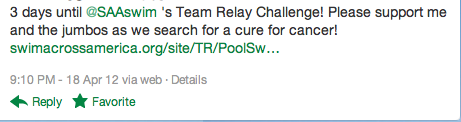


The organization even has their own Facebook page to generate buzz and raise awareness. Using social media does work. Both people whose posts I used went beyond the fundraising minimum (one even raised more than $1000). Social media gives people easy access to causes. College students, a group that widely uses Facebook, may not have a lot of money, but if 10 people give $10 that's $100 right there. Adults are also a growing demographic on social media sites and they may have more money to donate. Social media allows you to reach people all over the country and to really spread the word about your favorite cause. I am excited that so many people were able to use social media to promote Swim Across America and I look forward to future directions social media can take to create change, both with current social issues and worthy causes.
Sources: redistrictinggame.org, twitter.com, Facebook.com
Sunday, April 1, 2012
Advertising Overload
Hello readers! Sorry for the delay--I let a relaxing Spring Break get the best of me but I'm back. Last night I went to see The Hunger Games at the AMC Theater in Harvard Square. The showing was at 8:15 but when we arrived at 7:45 the line was already out the door. The theater quickly filled and after a short while the previews began for an audience happily munching away on overpriced popcorn and candy. This perplexed me a little since the showing was after most people's dinner hour. However, going to the movies is an experience that many people define as more than purchasing a ticket and spending two hours squashed in a theater. Rather buying a pop and box of candy seems to be part of the evening for many. The act of visiting the concession stand has now been conditioned into our minds.

Just before the movie started, there was an AMC commercial featuring Coca-Cola cups and bags of popcorn (with the AMC logo everywhere), as people around us slurped their drinks and popped kernels of buttery popcorn into their mouths. My friend who was stuffed from dinner even considered buying a bag of popcorn because she didn't want to see a movie without a snack. Movie theaters have figured out how to suck every dollar out of consumers' pockets. I would be curious to know how many advertisements people are exposed to during a trip to the movies. It starts with the posters lining the street showing upcoming movie posters and AMC promotional slogans. Once you enter, the concession stand is full of name brand snacks and drinks. More movie posters abound as you enter your theater. Leading up to the showing, the big screen often plays a mini-show featuring new television shows, popular brand products, and celebrities endorsing one-night events in theaters. During our wait, I watched promotions for Coca-Cola and Cirque du Soleil. Then we saw 6 previews! SIX! In fact, an article in The Los Angeles Time says that movie trailers are becoming as important and exciting as the main show (read here). Personally, I just wanted to see the movie. I was getting very anxious for the movie to start, but first we were treated to the AMC commercial mentioned above and a wireless provider (I can't recall which one) commercial about silencing your phones. The commercial conveniently featured characters from The Lorax...who of course urged you to come back and see The Lorax in a theater near you. Whew, I was exhausted just processing all these brand names. The movies are a huge industry and millions of people go to the movies. I am not a frequent movie-goer, so I was quite shocked by the advertising overload I experienced. Do you go to the movies often? Do you feel bombarded by all the advertisements?
Sources: Google images
http://articles.latimes.com/2012/apr/10/business/la-fi-ct-trailers-20120410

Just before the movie started, there was an AMC commercial featuring Coca-Cola cups and bags of popcorn (with the AMC logo everywhere), as people around us slurped their drinks and popped kernels of buttery popcorn into their mouths. My friend who was stuffed from dinner even considered buying a bag of popcorn because she didn't want to see a movie without a snack. Movie theaters have figured out how to suck every dollar out of consumers' pockets. I would be curious to know how many advertisements people are exposed to during a trip to the movies. It starts with the posters lining the street showing upcoming movie posters and AMC promotional slogans. Once you enter, the concession stand is full of name brand snacks and drinks. More movie posters abound as you enter your theater. Leading up to the showing, the big screen often plays a mini-show featuring new television shows, popular brand products, and celebrities endorsing one-night events in theaters. During our wait, I watched promotions for Coca-Cola and Cirque du Soleil. Then we saw 6 previews! SIX! In fact, an article in The Los Angeles Time says that movie trailers are becoming as important and exciting as the main show (read here). Personally, I just wanted to see the movie. I was getting very anxious for the movie to start, but first we were treated to the AMC commercial mentioned above and a wireless provider (I can't recall which one) commercial about silencing your phones. The commercial conveniently featured characters from The Lorax...who of course urged you to come back and see The Lorax in a theater near you. Whew, I was exhausted just processing all these brand names. The movies are a huge industry and millions of people go to the movies. I am not a frequent movie-goer, so I was quite shocked by the advertising overload I experienced. Do you go to the movies often? Do you feel bombarded by all the advertisements?
Sources: Google images
http://articles.latimes.com/2012/apr/10/business/la-fi-ct-trailers-20120410
Sunday, March 11, 2012
How Real is The Amazing Race?
Reality shows have become popular in the last decade with both basic television channels and cable networks adding shows to the growing list of reality programs. Reality shows are appealing because they feature regular people, not actors, often competing to win prizes or money. Other shows focus more on lifestyle and offer makeovers or searches for love. I am no stranger to reality programs and have followed The Bachelor, The Biggest Loser, Jersey Shore, What Not to Wear, Wipeout, and more. My favorite show though is CBS' The Amazing Race. Now in its 20th season, the Race features a cast of around 12 teams racing around the world for a chance to win 1 million dollars. Each episode features challenges and a team is eliminated almost every week another team is eliminated until they reach the final 3 that compete for the title.
In the past couple seasons, I have become more aware of product placement in the show. One popular brand featured is Travelocity. An online article (read here) talks about how The Amazing Race has the top integration product recall, meaning the people remember the brands they see advertised on the show. This season Ford is a major sponsor. In many episodes when the teams drive a car to the destinations, the car is a new Ford model. On tonight's episode, not only did the teams drive a 2012 Ford Focus, but they also used the Focus' active park system to parallel park at an auto museum where they searched for their next clue in a 1916 Ford Model T. Talk about a lot of advertising. Often in reality shows, the characters are provoked to say things that will match with the image created for each contestant. Although the shows are not completely scripted, they also are not natural. I have always loved The Amazing Race because it seems more real than most shows. However, on this week's episode I was a little disappointed with all the Ford placement. When the teams read their clue, each team emphasized that they would be using the active park feature on the Focus. After parking, several teams exclaimed "Go Ford" or "I gotta get me a Ford Focus". I am sure the active park feature is neat, but I also think the cameramen prompted more excited reactions from the contestants. Other viewers are noticing the same things as me. The website brandspotters.com even has a page dedicated to the show.(http://www.brandspotters.com/movie.aspx?id=618)
Now I am left wondering what other parts of the race aren't as real as I thought. I like to think that most of what I see on the screen is real, but after tonight's episode I think I will examine each week more carefully for real vs. not real. What are your favorite reality shows? How real do you think they are?
Sources:
http://www.mediapost.com/publications/article/172872/race-big-bang-top-product-integration-recalls.html
http://www.brandspotters.com/movie.aspx?id=618
Sources:
http://www.mediapost.com/publications/article/172872/race-big-bang-top-product-integration-recalls.html
http://www.brandspotters.com/movie.aspx?id=618
Sunday, March 4, 2012
To Buy or Not To Buy
According to my textbook for Media Literacy class, close to 4 billion songs were downloaded illegally in a month and this was in 1999! (Potter 2011) If you search the internet and newsstands alike you are likely to find stories about the great debate on music piracy. The record labels and artists are right to want royalties for their songs--after all they are the people who put their lives into making the music we love to listen to--however, there are some merits to getting your music fix via the internet. When listening to music on my computer I either use iTunes, Pandora, YouTube, or Spotify. All these sites are legal (iTunes because you purchase the songs and the other sites all have advertising that they use to pay the artists for the rights to play the songs), but I often supplement my iTunes purchases with illegally downloaded songs through sites such as listentoyoutube.com.


I once told my mom that I buy songs and albums for artists that I already know and love, while I download songs from artists I'm not as familiar with or songs I don't really like but want to have for whatever purposes. Prior to the shutdown of Limewire in October 2010 (for more information click here) I was an avid user of the site. You could easily search by artist, song, or album and click to download with the files easily added to your iTunes library. By downloading songs on Limewire, I was introduced to new artists and even a completely new genre--country. Today I am a huge country fan and will spend close to $200 this summer on tickets to see Lady Antebellum at a music festival and attend a 4-day country festival featuring Toby Keith, Blake Shelton, Luke Bryan, Jason Aldean and more. In the past year I bought 5 country albums in hard copies and purchased countless singles on iTunes. If I hadn't explored the genre through my downloads from Limewire, I may have never discovered some of my current favorite bands that I now support with albums and concert ticket sales.
I'm not saying that illegal downloading is a good thing, I just think that some good can come out of it especially for up-and-coming artists. I've heard newer bands thank people for listening and downloading via whatever medium because that generates buzz and bands need buzz to break out. So is downloading good or bad? In 2007, a columnist at The Seattle Times said that Limewire itself was legal, but people must use it correctly (Marshall 2007). I think this is a question that cannot be answered right now--there are many negatives to downloading, but I believe that bands and labels can benefit from it as well--and the great debate of to buy or not to buy will continue on.
Sources:
Potter, James. Media Literacy. 5th. SAGE Publications, 2011. Print.
Google images,
http://www.guardian.co.uk/technology/2010/oct/27/limewire-shut-down, http://seattletimes.nwsource.com/html/personaltechnology/2003533034_ptmrsh20.html
Sources:
Potter, James. Media Literacy. 5th. SAGE Publications, 2011. Print.
Google images,
http://www.guardian.co.uk/technology/2010/oct/27/limewire-shut-down, http://seattletimes.nwsource.com/html/personaltechnology/2003533034_ptmrsh20.html
Sunday, February 26, 2012
And the Winner Is...
Hi everybody, I'm Katharine "Juice" Majewski and I'll be keeping this blog updated weekly with my thoughts on all things media related. This week I'm currently blogging live from the Oscars. Okay, so I'm not actually at the Oscars--just watching--but I'm looking forward to a night of high fashion, celebrities, film, and of course commercials. The commercials have been almost as exciting as two of February's biggest events: the Super Bowl and the Grammy's. Both shows featured advertisements catered to completely different audiences. The Super Bowl spots were filled with cars, dogs, beer, and scantily-clad women--essentially all things male. In class, we spoke of the four dimensions of media literacy: cognitive, emotional, aesthetic, and moral. Most of the commercials during the Super Bowl appealed purely to our emotional and aesthetic senses. Both the Kia Optima and Chrysler commercials showed dreams filled with scenes of all things man and all things Americana respectively.
One week later, the commercials were marketed to an entirely different audience. They were more family-friendly and many included popular music such as Target's ad featuring Adele's "Rolling in the Deep". However, a standout ad from Chipotle really appealed to all four dimensions. With mesmerizing graphics and a Willie Nelson cover of Coldplay's song "The Scientist" (aesthetics), the ad emphasized sustainable agriculture supported by Chipotle (moral from the environmental standpoint and cognitive from the cost standpoint). By the time this ad was over, I felt happy (emotional) and wanted to head to Davis Square to get a burrito. Talk about an effective ad.
The textbook Media Literacy talks about how advertisers need to identify an audience and make them think they are offering them something new that they need. These four ads clearly did that and since have received much buzz. The Chrysler ad has over 10.6 million views on YouTube, while the Chipotle ad has 5.8 million views. These companies have constructed audiences and the people have responded by watching them on YouTube--I would be interested to learn how these ads have affected sales. What do you all think were the best commercials of the Super Bowl and Grammy's? Are you watching the Oscars--any commercials that have caught your eye tonight? Come back next week for some more freshly-squeezed Juice!
Sources: youtube.com
Potter, James. Media Literacy. 5th. SAGE Publications, 2011. Print.
One week later, the commercials were marketed to an entirely different audience. They were more family-friendly and many included popular music such as Target's ad featuring Adele's "Rolling in the Deep". However, a standout ad from Chipotle really appealed to all four dimensions. With mesmerizing graphics and a Willie Nelson cover of Coldplay's song "The Scientist" (aesthetics), the ad emphasized sustainable agriculture supported by Chipotle (moral from the environmental standpoint and cognitive from the cost standpoint). By the time this ad was over, I felt happy (emotional) and wanted to head to Davis Square to get a burrito. Talk about an effective ad.
The textbook Media Literacy talks about how advertisers need to identify an audience and make them think they are offering them something new that they need. These four ads clearly did that and since have received much buzz. The Chrysler ad has over 10.6 million views on YouTube, while the Chipotle ad has 5.8 million views. These companies have constructed audiences and the people have responded by watching them on YouTube--I would be interested to learn how these ads have affected sales. What do you all think were the best commercials of the Super Bowl and Grammy's? Are you watching the Oscars--any commercials that have caught your eye tonight? Come back next week for some more freshly-squeezed Juice!
Sources: youtube.com
Potter, James. Media Literacy. 5th. SAGE Publications, 2011. Print.
Subscribe to:
Posts (Atom)